
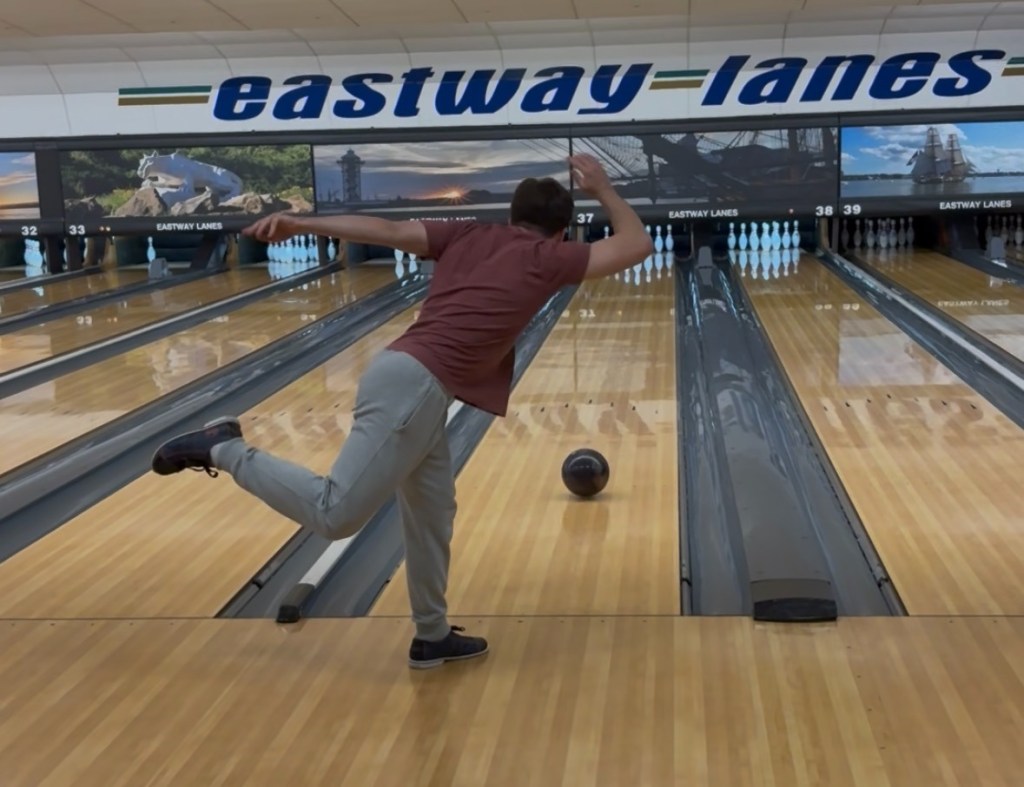
Bowling at Eastway Lanes, Erie
Have you ever wondered how professional bowlers like Pete Weber or Liz Johnson can score perfect games, or how they are able to manipulate the ball to get strikes? It all comes down to the interaction between ball, bowler, and lane. To understand the physics of bowling, you must first understand Newton’s Laws of Motion.
Newton’s Laws of Motion
Newton created three fundamental laws to help describe the relationship between forces and the motion of an object. Newton’s first law of motion, the law of inertia, states that an object at rest will remain at rest, unless acted upon. If acted upon, an object in motion will continue at constant velocity. This motion can be stopped if an external force is applied in the opposite direction. Newton’s second law of motion states that an object’s acceleration depends on its mass and the forces acting on it, or the net force is equal to mass times acceleration. Newton’s third law is typically referred to as the law of action and reaction. Basically, when one object exerts a force on a second object, the second object simultaneously exerts an equal and opposite force back on the first object.
Forces Acting on Bowling Ball
Now that we learned about Newton’s Laws of Motion, we can apply these laws to bowling to help describe what happens in the interaction between ball, bowler, and lane. To start, Newton’s first law applies because the pins and ball are at rest when you start. Once you start to throw the ball, you give it velocity. Your arm acts like a pendulum, and you release the ball. Releasing the ball puts it into motion (V). Depending on how much force you give the ball and how heavy the ball is, the ball can have a greater acceleration, which can result in greater impact when hitting the pins. As the ball rolls across the lane, the ball’s weight pushes down onto the lane (Fg), and the lane pushes back up onto the ball, resulting in a normal force (FN). As the ball hits the pins, or the back wall if you have a gutter ball, the first law applies, as the ball’s motion stops. The image below shows the forces acting on the ball, as it slides down the lane.
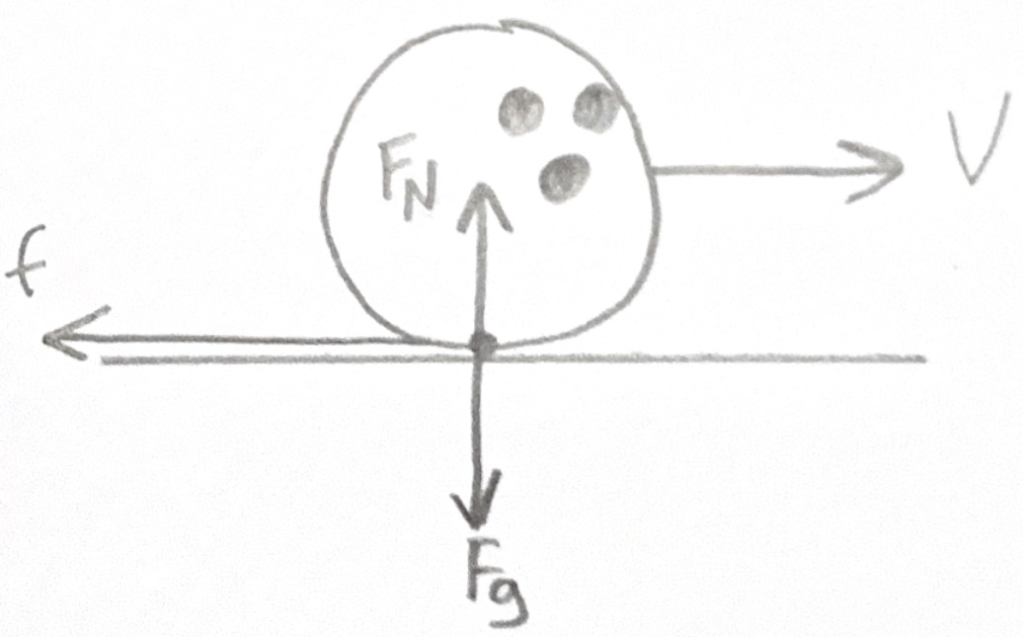
You may have noticed that there is another force on the diagram, f. This is a friction force, which opposes the force used to put the ball into motion. Where is this force coming from?
Lane Conditions: Effect of Oiled and Dry Areas and “Hooking”
The lane applies a normal force to the ball, but also a friction force. The frictional force direction and effect on the ball is dependent on how the ball is moving and rotating. There are different ways in which the lanes are oiled, but most of the oil resides in the middle. The oil reduces friction, allowing the ball to glide across the lane. Once the ball hits a dry spot on the lane, friction allows the ball to curve, or “hook”, into the pins or gutter. This “hook” is determined by the surface and core of the ball, and the release of the bowler. Depending on how you bowl, one-handed or two-handed, your hands or fingers at release determine how much the ball hooks.
Conclusion
Now that you know the physics of bowling, you can bowl with confidence, even though you will still get gutter balls.
By: Tyler Couch


Leave a Reply