
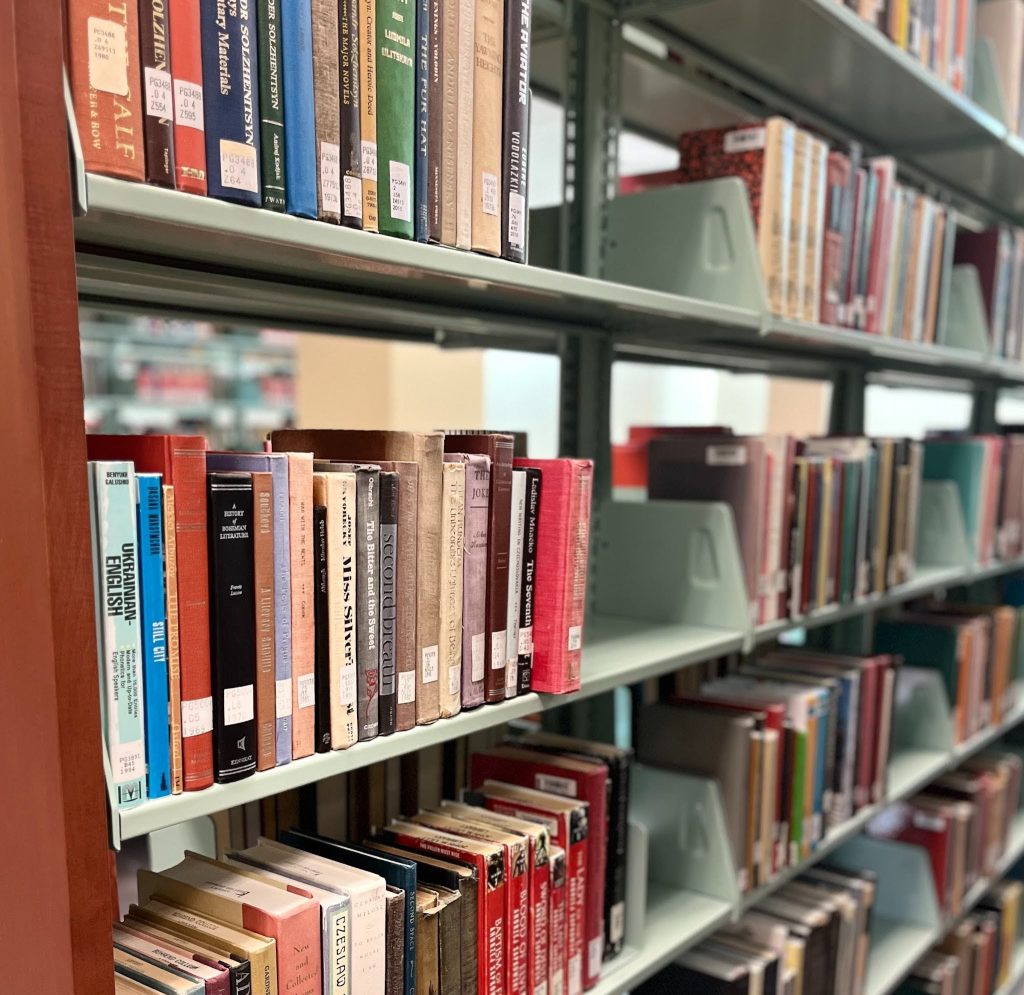
Books in and on foreign languages on the ground floor of Lilley Library.
For many, foreign languages are invisible.
Their study is relegated to Spanish 101 or Introductory French, courses full of flashcards and grammar worksheets and class periods spent saying, “I have two sisters. I don’t have a cat. The pen is on the table.” Languages appear as the villains in our nightmares, with us frozen standing before a class as we attempt to produce sounds we have never before had to produce. Due to these experiences, perhaps we may think of foreign language only as a Pass/Fail grade to be stamped onto a transcript and move on.
Sure, language learning staves off dementia. It’s good for future opportunities. But those benefits seem light-years away! Right now, the learning process feels only painful and embarrassing, nothing but another load of memorization dumped onto our plates. But is this really all foreign languages are?
Saul Gamboa doesn’t think so. As an international student from Venezuela whose first language is Spanish, he believes bilingualism enhances his life now. I sat down with him and several other international students in a hallway at the Kochel building. When I asked them, “What would life be like if you only spoke English?” the hall seemed to fall silent.
Saul thought for a second, then shook his head. Finally, he said, “Man, I think life would suck.”
Languages season our lives much as spices season food. We enjoy tasting dishes from various cultures because we can get a glimpse into what others enjoy, what they cherish, and how they live. The high turnout at Behrend’s Global Ambassadors events, where foods from many nations are showcased, illustrates how much we enjoy immersing ourselves into other ways of life. Similarly, each tongue we speak carries a distinct flavor. By speaking and mixing all of them together, we can gain more taste out of each experience.
In fact, because every language is different, we can only approximate what their words might mean. Dr. Laurie Urraro, assistant lecturer of Spanish at Penn State Behrend, explained that “we are never, almost never going to be able to do an accurate word-for-word translation.” She prefers what she called “sense-for-sense translations.” While we can sense what others may mean by their translations, we fail to reach their full meaning.
Even fellow students understand how irreplaceable foreign languages are. Anindhita “Nindhi” Farras and Renan “RG” Rumambi are both international students from Indonesia, but they have a long, complicated relationship with English. Nindhi spoke English for years at school, and RG entered an American international school in eleventh grade. Now, they primarily speak English. Yet, when trying to comprehend how life would be without their other languages, RG reached for the nearest, most vivid word he could think of: a slang word in Indonesian.
Pondering what might happen if he spoke English in Indonesia, he said, “If I, you know, spent sixteen years only speak[ing] English, like, people would look at me weird, and, like…”
RG paused briefly, as if scrambling for the exact phrase. In the end, he came up with “sok-sok[an] orang Amerika…”
Nindhi joined in, laughing. A spark of mutual understanding came from being in on the joke and understanding what he meant.
I speak Indonesian, but not very well, having learned it later in life. I had never heard this word before and wanted to understand these nuances for myself. However, the native Indonesian speaker I asked struggled to explain what sok-sokan means. She explained it as partially “pretentious,” partially “a snob,” and partially “pretend[ing] to be” someone you are not. Only when she explained in a mishmash of Indonesian and English did I understand. I also needed Indonesian to supplement this “sense-for-sense translation.”
Nindhi and RG, though, grasped the meaning at once, all wrapped up in one word, in the Indonesian they feel and live: sok-sokan.
RG continues to embrace language diversity. While he already speaks English, Indonesian, and Manadonese, he is also inundated with the Spanish from his three roommates at Behrend. His roommates often speak Spanish among themselves, throwing in a sentence or two of English here and there. RG embraces this multilingual environment and does not want to lose any of these languages. He hopes to learn from his roommates and says, tongue-in-cheek, that he will soon reach “maximum fluency” in Spanish being around them so much.
If nowhere else, college blends all of us into a multicultural gumbo where we can teach others and learn ourselves. At Behrend, the international students come from places as far from one another as Bangladesh and Brazil, as Saudi Arabia and Singapore. Therefore, in front of us is an opportunity to savor for ourselves the multilingual stew, the cultural melting pot. We can dip our tongues into a language and enjoy it, not as bland memorization, but as an asset that introduces us to new and exciting flavors.
Amanda Ong


Leave a Reply