
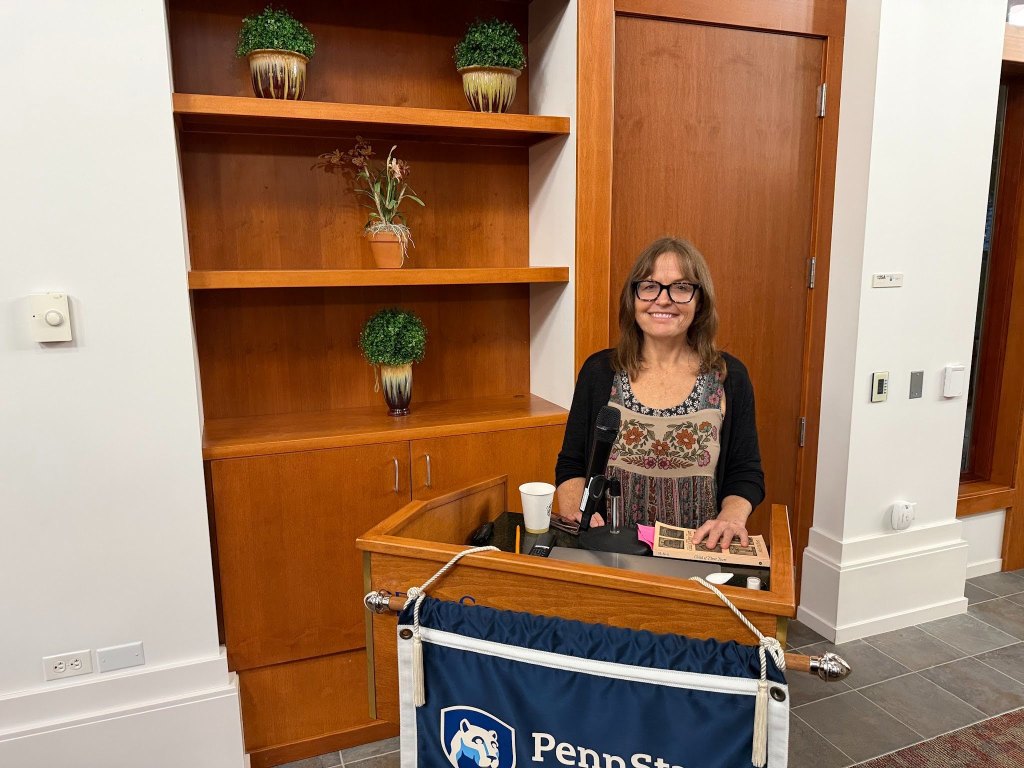
Molly McNett’s writing has appeared in The Best American Short Stories, The Pushcart Prize anthology, as well as several literary journals. Her story collection One Dog Happy won the John Simmons Award for short fiction from the University of Iowa Press, and her new novel Child of These Tears was named in The New Statesman as one of the best books of 2025 by critic Rowan Williams. On Thursday, Oct. 15, McNett visited Behrend to read some passages from her new book for our Creative Writers Reading Series.
The night’s reading began with a few words from creative writing professor Thomas Noyes who praised the book for both its excellent writing—the kind that makes a good writer jealous—and its ability to play with those darker truths of suffering. McNett isn’t afraid to let her characters “go through it,” so to speak. As Noyes observed, discussing the characters’ struggle, “If there’s salvation, they often have to find it for themselves, and they must find it where they are.” This is just one of many facets of McNett’s fiction that makes her work so evocative.
After finishing up his introduction, Noyes invited McNett up to the lectern where she read six chapters from her book. The story is set in colonial America in the early 1700s. It’s fragmented into journal entries and letters with a primary focus on our young protagonist Constance Baker.
There are certain books for which reading is perfunctory. Visiting the page is not a joy, but the first obstacle between you and a really good story. For McNett, however, the words become that driving force. You get excited to open the page and dig into what feels like a genuine historical document. Suddenly these people’s distress becomes real enough to put aside your own worries. During this brief lapse of time, I found myself flinching for an eight year old girl named Constance who gets beaten by her mother. I got hot and itchy at the raw descriptions of nature and its unrelenting swarms of biting insects. My heart tensed as these innocent not-so-innocent villagers fell under attack by the so-called “savages,” and I couldn’t help but get a little queasy at the thought of eating a mouse to cure my toothache. Then it was over. Suddenly I was back in Metzgar, and McNett was taking questions from the audience.
For those aspiring writers, McNett points to what John Gardner calls “divine stubbornness.” McNett says, “Mostly it’s just putting your head back down over and over and over again.” For those who wish to know her personal ratio of reading to writing, she estimates it around 70 to 30. She says she loves the process of research and therefore doesn’t really mind protracting it. Finally, for those who wonder if Molly McNett also struggles with motivation from time to time: yes. Yes she does.


Leave a Reply