
Chase Burdick
Business and Science Editor
cxb1345@psu.edu
Bing chat, less than a year old, is one of the top three products that come to mind regarding Large Language Models, LLMs, and their Artificial Intelligence, AI, applications. While the top three tend to mirror each other with their innovations and use cases, they do not all have a tech giant at their helm.
Being as successful as it is, Microsoft can afford to do many things. One thing it does not seem able to do is keep up with the energy bill for its growing Bing chat baby. That being the case, it has decided to take proactive action and try to meet or at least keep up with the growing energy demand caused by the advancement of LLMs. Microsoft is now seeking someone to head its emerging Nuclear Program. That is right, Microsoft is going Nuclear!
For those who do not know, this is not something to be concerned about. Nuclear energy is one of if not the cleanest, energy sources in terms of radiation output. The emission of fly ash from coal power plants, for example, sends out 100 times the radiation a nuclear power plant producing the same amount of energy does. In addition, Microsoft is one of the biggest tech companies. Nuclear power is safe in their hands. Cofounder Bill Gates is even the chairman of the board for TerraPower. TerraPower, a nuclear innovation company, works on small modular reactor designs.
Small nuclear reactors are just what Microsoft is looking for. It plans to integrate modular and micro nuclear reactors into the Microsoft Cloud and AI data centers. This strategy will save Microsoft money on its power bill and make it independent of energy companies, assuming they generate enough power for all their operations.
Microsoft is not stopping there, either. To ensure it has enough energy for its operations, it has signed an agreement to purchase power from a nuclear fusion startup, Helion, beginning in 2028. If you do not know, people have yet to recreate nuclear fusion on Earth. It occurs when “two light atomic nuclei combine to form a singular heavier one while releasing massive amounts of energy,” according to the International Atomic Energy Agency. Nuclear fusion has never been accomplished on Earth since we only know how stars do it. The massive gravitational pulls of stars combined with their scorching temperatures allow the attractive forces of the nuclei to overcome the electrical repulsion forces they have on one another, resulting in their fusion. The International Atomic Energy Agency also claims nuclear fusion can generate “nearly four million times more energy than burning oil or coal. Better still, nuclear fusion would be practically unlimited in its source while also being clean and safe.
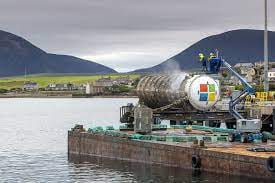
Previously, Microsoft experimented with housing their data centers underwater, which not only was able to produce energy for them but also cool them at the same time. Its project, Project Natick, spent two years testing the performance of its design. The test entailed dropping a data center 117 feet to the seafloor in a sealed container. The team behind Project Natick explained “that a sealed container on the ocean floor could provide ways to improve the overall reliability of data centers. On land, corrosion from oxygen and humidity, temperature fluctuations, and bumps and jostles from people who replace broken components are all variables that can contribute to equipment failure.” The improvement in reliability was the team’s hypothesis going into the test.
Their testing proved their hypothesis correct. The implications are that data centers can then be put along the coast near population centers, offering them access to cloud services at “lightning-quick” speeds. Since seas’ temperatures are consistently cool beneath their surfaces, this could create scenarios allowing for energy-efficient data center designs. Microsoft gave the example of heat-exchange plumbing used in submarines. However, Microsoft could also investigate possibilities such as hydroelectric or steam power implemented into the data centers.
With more than half the world’s population living within 120 miles of a coast, this is a huge step forward for cloud computing. This progress was especially telling when phase two of Project Natick proved that Microsoft’s design was practical. Microsoft is making big waves in sustainable energy practices, so let us see who can keep up and who gets washed away in the tide.
Project Natick being retrieved off Scotland’s Orkney Islands after two years underwater

A glimpse of the inside of the capsule that data centers were in, as engineers prepare it to withstand its two-year underwater duration



 The Behrend Beacon
Leave a comment