
Nathaniel Clark – A&E Editor
nuc5002@psu.edu
Photo Credit: Nathaniel Clark/ Behrend Beacon
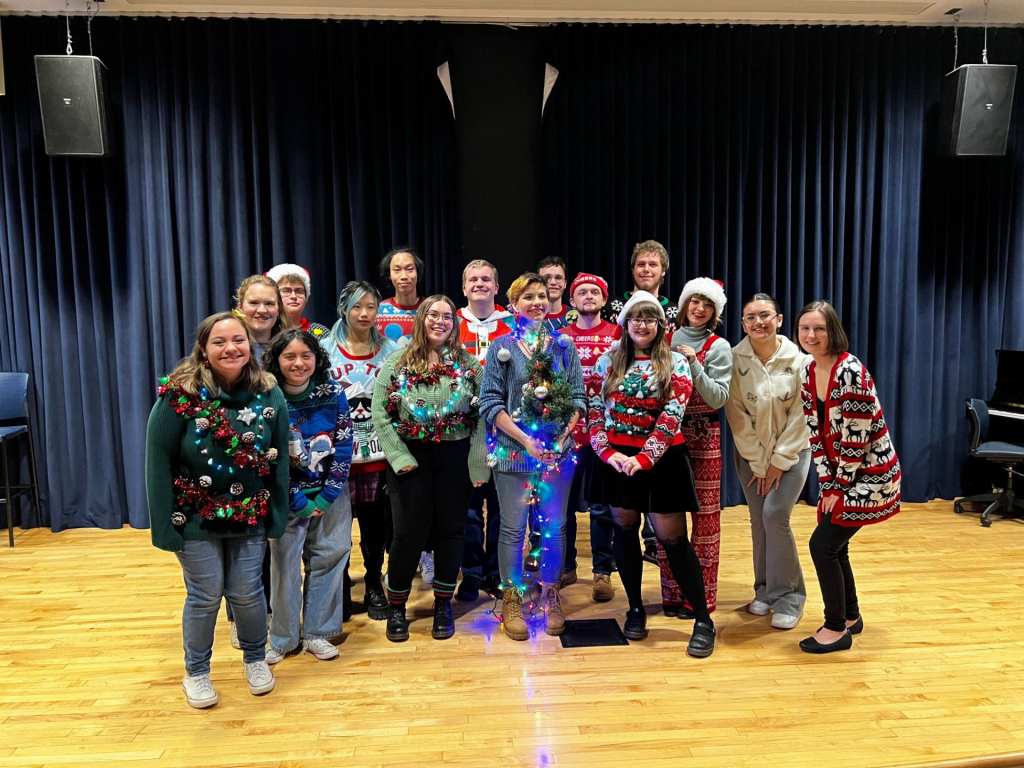
On December 4, Tone-Acious, Behrend’s first and only acappella group, performed their winter concert in the Reed 117 auditorium.
For anyone unaware, acappella is a musical form where a singer or a singing group performs without instrumental accompaniment. Acappella groups usually perform pieces in a vocal-only format. While acappella has its history in early worship songs, modern acappella has spread throughout all genres. Contemporary examples of acappella include the group Pentatonix and the song “Don’t Worry Be Happy” by Bobby McFerrin.
Tone-Acious began at Penn State Behrend in the spring of 2013. Since then, the acappella club has performed a multitude of concerts and various performances at other Behrend events. So far this school year, Tone-Acious has only performed one other concert.
As members of the group collected Behrend students’ Event Passes, some Tone-Acious members performed solos. Since these solos were performed by one singer, a backing track was used. One of these was “A Million Dreams” from “The Greatest Showman” and another was “Dreams” by The Cranberries.
After these performances and a small pause, all of Tone-Acious swarmed the Reed stage and got into the proper position. Dressed in their best festive attire, the group started their performance cheeky with Rick Astley’s “Never Gonna Give You Up.” Following applause from the audience, Tone-Acious’ club president Emily Green introduced all members of the group before heading into their next song. Promising that some holiday classics would be coming, Tone-Acious conducted a suite of pop classics which started with The Jackson 5’s “I Want You Back” and ended with Kansas’ “Carry On My Wayward Son.”
There then came a short round of individual solos from Tone-Acious members. These solos were quite special as they were instrumentally led and usually played by the same member singing. This included a ukulele-led “Hotel California” and a morose-styled “Mr. Sandman” with assistance from the piano. The main kicker from this group was the performance of “The Parting Glass,” a traditional Irish funeral song whose history began in the early 1600s. Uniquely powerful and somber, this song stuck out to me.
An acclamation of audience cheers and whistles led into an interesting portion of the concert. First was a performance of “BOY” by Little Mix only delivered by Tone-Acious E-Board members. The audience was then treated to some sectional-specific arrangements.
For this section, the group’s tenors and basses conducted their rendition of Bastille’s “Pompeii” while the altos and sopranos decided to conduct their version of “Blackbird” by The Beatles.
All of Tone-Acious then returned to the stage to deliver the holiday classics which they had promised in the beginning. They began with the classic “Carol of the Bells.” With its haunting vocal layers filling the auditorium air, the performance was quite the sight.
To close off their concert, the group said that they were going to perform “The Twelve Days of Christmas.” Unaware to the audience though, Tone-Acious had an ace up their sleeve. Rather than performing the traditional rendition of the track, the acappella group chose to adapt the Straight No Chaser version. Known for its sudden mixing of different Christmas classics and its random interpolation of Toto’s “Africa,” the song sent waves of laughter throughout the audience. Once the song was finished, the crowd delivered its ovations toward Tone-Acious and photos began to be taken.
With more concerts and new member tryouts coming in the next semester, it is a great time to support Behrend’s only acappella group.

 The Behrend Beacon
Leave a comment